‘Crypto Certs’ offers art-world investors a more active role in the production of art, revising traditional models of funding. Although in its early stages of development, Fornieles hopes his model will be adopted by other artists too, replacing established methods of financially fuelling their creations.
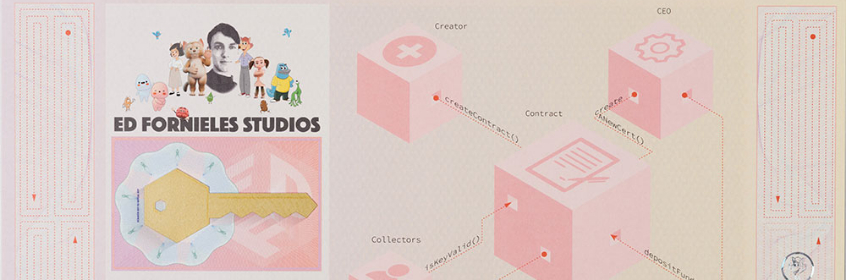
Seeking to alleviate the pressures of creating conceptual art for both artists and galleries, the project encourages collectors to invest in an artist’s career, as opposed to a single piece. Thus, in purchasing a ‘Crypto Cert’ – original prints designed by Fornieles – an investor pays €550 for not only the original piece of art, but also a share in future profits. The certificates, inspired by Brad Troemel’s bitcoin-embedded sculpture, come in two types: an investment in a Studio Cert supports the studio as a whole, and offers its buyers a gradual and sustainable return on their investment from the whole studio’s output; the Project Cert, on the other hand, is designed to fund specific projects and entitles its holders to a percentage of sales from that project alone. Funds generated by the sale of the certificates contribute to the development of the artist’s future projects.

ATHENS BIENNALE OFFICAL CERTIFICATES
PROJECT CERTIFICATE
DATE:JULY/18
GEN: 1.0
PRICE: €550
Each certificate employs Ethereum blockchain technology which stores and distributes value. A key is embedded under a scratch panel, which entitles the holder a percentage of an Ethereum fund which grows with every further certificate sale. The only way to cash out is to scratch the panel and damage the certificate, raising the question of whether financial profits are ever more valuable than the artwork itself. “When the collector goes ‘fuck the art’”, commented Fornieles to Dazed, “it becomes nothing more than a speculative investment. What does it take to retain the integrity of the work?”
By relying on larger networks of support, Fornieles hopes his funding model will relieve some of the risk from investing in artworks (removing the reliance on a small, centralised group of high-risk investors) and will subsequently encourage artists to be more original: “the current system rewards repetition of past successes, so you end up getting into loops of repeating the same type of work over and over again just for the sake of survival”. The flip-side of the coin, however, is a possible future where “everyone is trading themselves on an open market, selling their futures in the hope they might transcend and reach blue-chip status.”
Katy Cross