Until February 5th, 2022, the Jecza Gallery in Timișoara, Romania welcomes the exhibition "Apud Magister" of the well acclaimed Romanian painter Ioan Aurel Mureșan, curated by Liviana Dan. On this occasion we discussed with the gallerists Sorina Jecza and Andrei Jecza.
Did you have any surprises, any curious discoveries that came along during the opening of the recent exhibition ‘Apud Magister’ at the Jecza gallery?
Sorina Jecza: "Apud Magister" is the first solo exhibition of Ioan Aurel Mureșan organised by Jecza gallery after he joined our portfolio of artists. Ioan Aurel Mureșan is a painter from the ‘80s generation and a professor of painting at the University of Art from Cluj, with a strong presence on the Romanian art scene up to the beginning of the 2000s, but less visible afterwards.
The revelation that the exhibition Apud Magister brings is the restoration of rights of painting, as a “classical” medium of expression, the inner revival, fueled by its own resources, of this practice, and its transformation into a contemporary form of expression. Employing the techniques that came with modernity, Mureșan “dismantles” classical artworks from the history of painting – from the Renaissance until today – and reinterprets them in a personal manner, bringing a new life into some major iconic forms. His art gives contemporary painting a new chance, in keeping with the crucial themes of contemporaneity.

Ioan Aurel Mureșan, Cascada. Apud Rubens 2020 — ulei pe pânză, 150 x 200 cm Courtesy of the artist
Could you describe to us your first ‘meeting’ with the art pieces of Ioan Aurel Mureșan? Your emotions, thoughts that arose after the first contact.
Sorina Jecza: The first meeting with Mureșan’s artworks took place at the “storehouse from the mill” – the place the artist was using for storing his paintings that had not been exhibited for the last fifteen years. I’m quoting a diary entry that recalls the moment of that encounter: “The mill… a building that preserved only dim signs of a beauty long gone. The storage was a room full of paintings, which the painter seemed to not have set foot in for a very long time. He had constantly been postponing facing his own artworks. I could sense his stubborn unwillingness. All around, tens of paintings, facing the walls. After a cigarette or two, smoked in silence, he started to turn them around, one by one… The first canvases happened to come from the series he called “Ultrasilvania”. He didn’t explain the title. They followed, one after another, in an uneasy tension, like a sort of a ritual. Heavy with paste, in dark colours, they all shared a smouldering dramatism, leaving only the ash of silence to hover over us in the room. Everything was eerie. I could feel the painter becoming more and more enticed, as if he was discovering himself something he had not known. Something he had forgotten, perhaps. He told me the artworks had never been exhibited. It was as if he was also seeing them for the first time. He looked at each one of time, sniffing something that was hidden in the thick paste. Hours went by… I didn’t realise when. At the end the painter asked me what I thought about. I was not able to articulate any judgement… I only had the vague intuition that that pasty magma was sheltering the energy of a volcano about to erupt. I could feel its confined force. I left the mill exhausted, convinced I had witnessed something important I couldn’t understand. And I also had the conviction that it was I who had to free that dense core that radiated explosively on the surface of the canvas.”

Ioan Aurel Mureșan, Variațiune 11 — 2021, ulei pe pânză, 70 x 100 cm ; Variațiune 12 — 2021, ulei pe pânză, 70 x 100 cm Courtesy of the artist / Courtesy of the Jecza Gallery (Photography)
It was a process that spanned over an entire year. A year of searching, documenting, analysing, transcribing texts, going through the archives, retracing paths with the fervour of an investigator that follows his instinct. And ever since I embarked on recuperating this important body of work, still unknown to the younger Romanian generations. To begin with, I have organised an exhibition at the Museum of Art from Craiova, and then we added the artist to the gallery’s portfolio. For a whole year I have assisted the birth of this latter series, which is now exhibited in the gallery. A catalogue covering that “work in progress” of the paintings will come out soon. It will include the phases of the making of these artworks, like a sort of a painting diary of the artist.
How does the gallery position itself on the international stage? What role is assigned to it locally?
Andrei Jecza: Jecza Gallery, founded in 2011 în Timișoara/Romania, had from the outset a strong propensity for the local historical scene, very important in the ‘60s and ‘70s (sculptor Peter Jecza, the Sigma group, among others). It represents artists and artist collectives, historical figures but also young and prominent personalities with a special interest in contemporary sculpture and experimental art forms. Through curated juxtapositions of artists of different generations, the gallery encourages in-depth research projects related to various art practises. Together with the Triade Foundation and the publishing house, founded in 2000, the gallery became a strong research centre for the heritage of modern and contemporary art in Eastern Europe. In 2021 the gallery celebrated its 10th anniversary with a group exhibition curated by Ami Barak.

Peter Jecza © Jecza Gallery
With the beginning of a new decade the gallery enters into a new phase of its development. The intention is to diversify Jecza Gallery’s portfolio, to continue its research based on curated programmes dedicated to historic stances from East European countries, and to discover new talents - with a great emphasis on painting and photography. Currently, the gallery represents 14 artists, including artists like Paul Neagu or Peter Jecza, historical figures like Constantin Flondor and Doru Tulcan, and new emerging artists like Tincuta Marin, Pusha Petrov, Ana Adam. Recently the gallery has started to represent and exhibit internationally a great number of female artists such as Tincuta Marin, Pusha Petrov or Ana Adam.

Constantin Flondor © Jecza Gallery
Could you tell us about the gallery's significant projects/exhibitions of the past, worthy of attention? Could you name and describe a few?
Andrei Jecza: It’s hard to say which exhibition is more significant than the other. For us, as a contemporary art gallery, the most fulfilling moments are defined by milestones of success. One of these milestones happened in 2014 after we have organised a series of exhibitions dedicated to the Sigma1 Group – going from a collateral project in the Venice Biennale to the acquisitions made by Tate Modern or MUMOK Vienna that included the works of Constantin Flondor and Doru Tulcan in their permanent collection from Vienna.
As presentations in dialogue have always been very important to us, one of the most exciting projects was the juxtaposition of Albanian painter Genti Korini and Constantin Flondor.
Another important step for us was the collaboration with Ami Barak, firstly for the exhibition Serving Art Again, showcasing the work of subREAL (Iosif Kiraly & Calin Dan), followed by the presentation of the group at Paris Photo 2019; secondly, for the curation of Ana Adam’s solo show Drawing is witchcraft or the other way around, followed by her solo show at the National Museum of Contemporary Art, Bucharest, and, more recently, for Pusha Petrov’s solo show The Unspoken and Other Images in 2020.

Pusha Petrov © Jecza Gallery
Another notable moment was the exhibition and the discovery of the female painter Tincuta Marin, followed by her first museum solo show in Cluj. The young artist proves to be a new sensation emerging from the Cluj School of painting with three major shows scheduled for this year.
Our long-lasting collaborations with artists such as Constantin Flondor, Genti Korini, Roman Cotosman, Ciprian Radovan, Iosif Kirlay, and many more, the numerous publications, art fairs, and projects are a good example of our dedication.
Do you think that Romanian art and its art market exists and develops according to its own laws? What, in your opinion, sets it apart, what makes it special? What tendencies can be traced in collecting contemporary Romanian art? What works / artists are currently the most popular among collectors? Which ones remain underestimated, but, in your opinion, would/should be a part of any decent collection?
Andrei Jecza: The Romanian art market is like all regional markets, it pays a great attention to national “heroes”; while some remain relevant only nationally, others gain international importance. Sometimes it also happens the other way around – artists gain international acclaim first and only later they get noticed locally – as was the case with Marius Bercea, Victor Man, Serban Savu, Adrian Ghenie, and so on.
We feel the Romanian art market today develops into two different directions that are both very promising. On one hand, the rediscovery of historic artists who were pioneering sculpture, installation, video, photography, and happenings in the early ‘70s; on the other hand, the emergence of a new generation of artists with a classical training and a great appetite for painting or sculpture.
When we started the gallery, the historic artists from the ‘60s and ‘70s were not at all “interesting” or “hot”. As we have “matured”, so did the market. Ten years on such a young market means a lot. Now we are witnessing the discovery of the 80's, (Ioan Aurel Muresan), 90's (Sorin Vreme), and the 2000s generation.
As for us, on one hand we represent historic artists: among the most celebrated being Constantin Flondor, Roman Cotosman, Paul Neagu. We are also noticing the revival of sculpture; after a few years of lack of interest, bronze sculptures by Peter Jecza are starting to be collected again; on the other hand, we see a great appetite for young painters, especially female artists - Tincuta Marin is definitely a name to look for, as she has already started to enter important collections. Another artist that has a lot of success is Genti Korini.
On what projects the Triade Foundation is focused at the current moment? Could you share with us its future plans? Tell us briefly.
Sorina Jecza: The Triade Foundation has several components: the gallery for contemporary art, founded and run by Andrei Jecza, has its own exhibition programme. In parallel, the Foundation is involved in the programmes it has been developing from its very establishment, in 2000. These range from the promotion of sculpture (and, considering that Timișoara will be an European Capital of Culture, our efforts focus on renovating the Sculpture Park of the Foundation, that counts over 40 large scale artworks, and also on setting up the Jecza Museum, that houses over 1000 artworks of the artist) to organising some major exhibitions together with curators who have a particular interest in sculpture (Alina Șerban, Călin Dan, and Celia Ghyka), in partnerships with museum institutions.
Independently, we will continue the recovering of Ioan Aurel Mureșan’s work, by publishing an extensive chronological catalogue, making a presentation website, and exhibiting previously unshown artworks in proper contexts (i.e., an exhibition at the Museum of Art from Cluj, in May).
Not lastly, this year the foundation will also continue the programme of enlarging the art public, developed in partnership with Louvre Museum.
What is happening in Timișoara right now on its contemporary art scene?
Sorina Jecza: Timișoara has been appointed European Capital of Culture for 2023, therefore, even as we speak, the local partners are working on coalescing a consistent programme devised to increase the international visibility of the city, by making a powerful presentation of our values. The Triade Foundation and Jecza Gallery are, among other important participants to Timișoara’s art scene, like the Art Encounters Foundation, to whose establishment we have contributed as co-founding members, important players. The Art Encounters Biennial in which we are also involved, as co-organisers, is such an example of bolstering Romanian art on the international scene. I strongly believe that these examples I have mentioned prove that we have plenty to offer to those interested in art, in general, and in contemporary art, in particular.
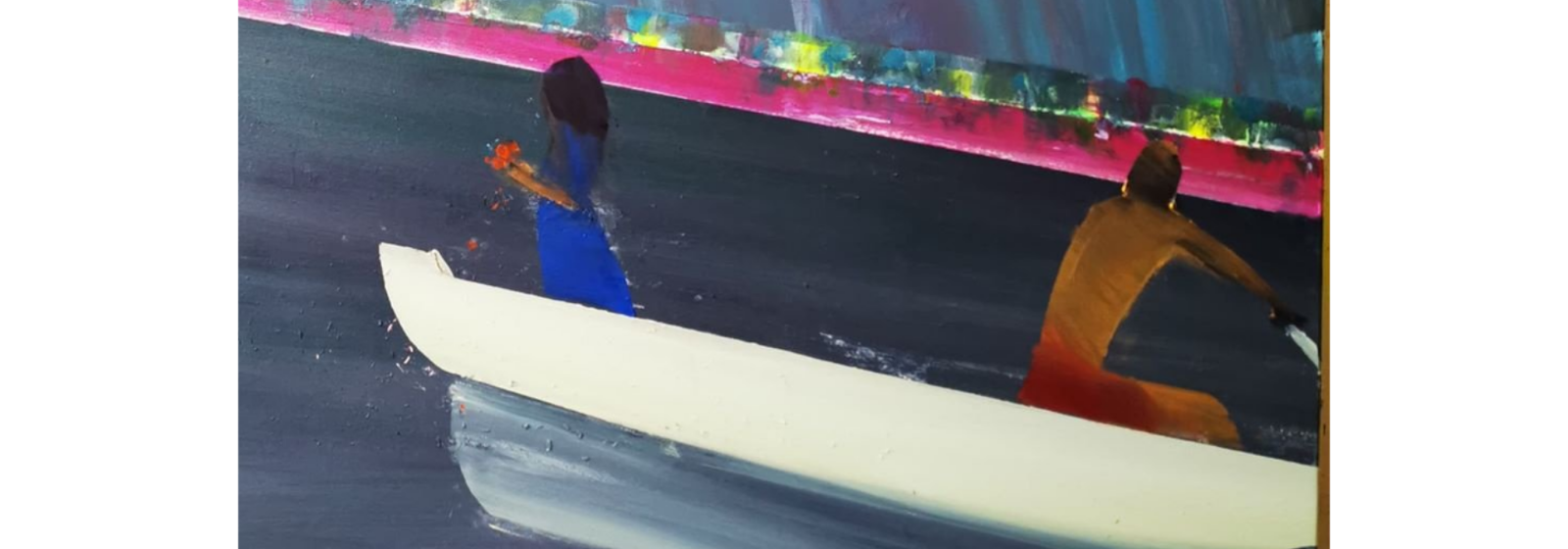
cover image: Ioan Aurel Mureșan, Luntrea lui Charon. Apud Patinier 2020 — ulei pe pânză, 150 x 200 cm Courtesy of the artist © Jecza Gallery